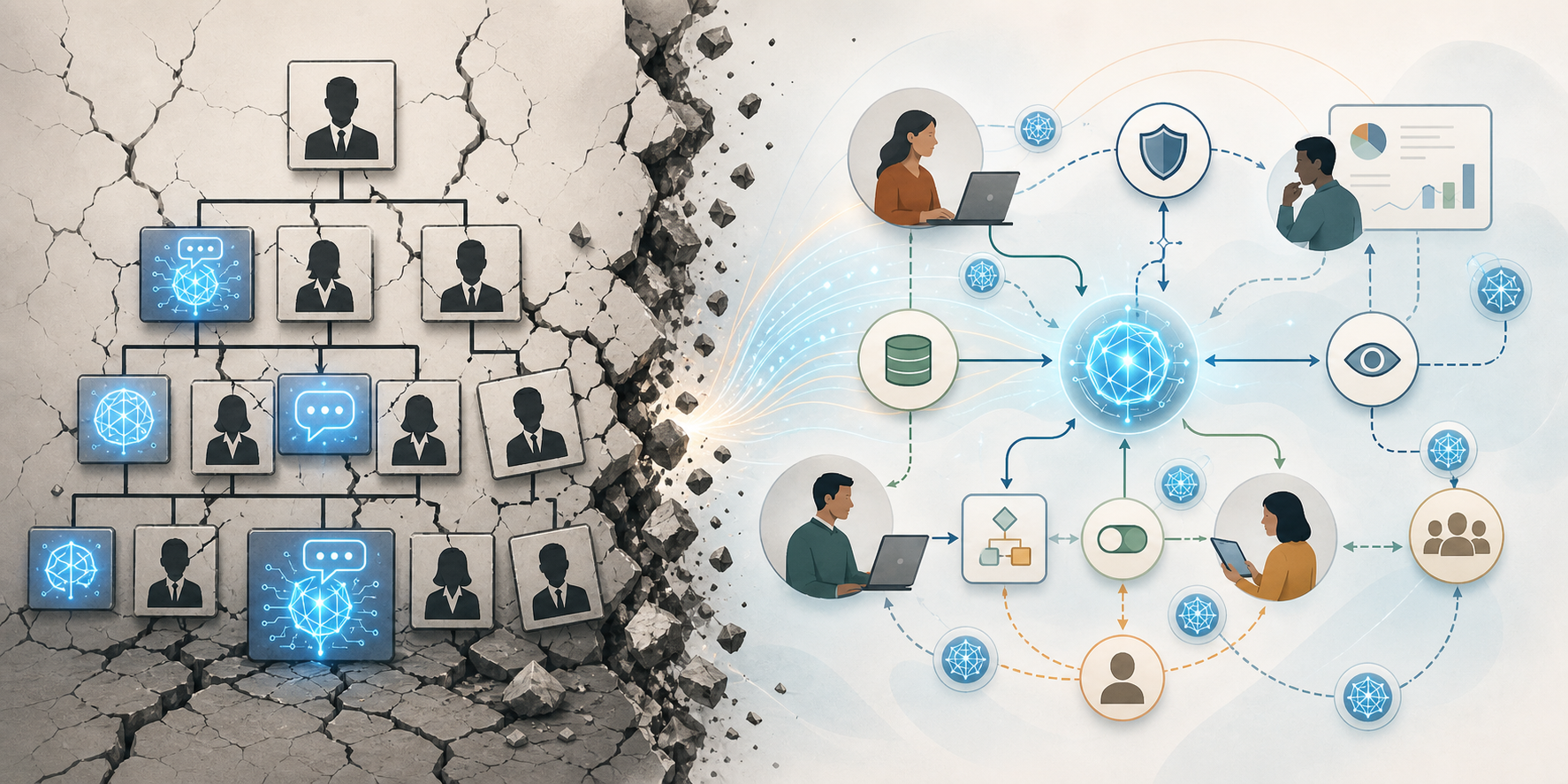
Why AI Agents Don’t Belong in the Org Chart – What You Need is an “Enterprise Operating Map”
Nobody ever put SAP in the org chart.
For decades, enterprise software has been doing work once done by humans. ERP systems coordinate resources. CRMs structure sales. Workflow engines route approvals. Recommender systems shape decisions. RPA bots click through back-office tasks. Machine learning models score credit, detect fraud, rank candidates, forecast demand. These systems influenced work without presenting themselves as workers. And no one felt the urge to draw them a reporting line.
Now that large language models (LLMs) are being packaged as “AI agents”, the instinct has changed. The software got better at conversation, and we mistook that for it becoming a colleague. LLM-based agents speak in natural language, ask questions, explain their reasoning, and present themselves as role-like entities such as researcher, assistant, reviewer, coordinator. That makes them psychologically legible in a way a fraud model never was. The software is being personified because it now performs a role-like interface, not because it has become a true organizational actor.
But organizations do not just adopt technologies. They also adopt metaphors. And metaphors shape management decisions. Suddenly digital coworkers, AI teammates are appearing on org-chart diagrams as if they were new hires. McKinsey popularizes the “agentic organization.” Vendors pitch “digital employees”.
My view: this is a category mistake with a rational core.
The category mistake
An org chart is intended to map authority, accountability, and reporting lines among humans. An AI agent has none of those things. It has permissions, prompts, model behavior, and a human somewhere who owns the risk.
The org chart cannot tell you what data an agent can access. It cannot tell you what happens when the agent fails at 2 a.m. It cannot tell you who approved the deployment, where the kill switch is, or who is authorized to pull it. It was never designed for those questions. Assigning a label is not the same as building controls.
If you have been in a leadership meeting where someone presented an org chart with AI agent boxes and the room moved on feeling organized that is the moment to worry. Not because the diagram was shown. Because nobody asked what was underneath it.
The rational core
Dismissing this entirely as hype would be too easy. There is a genuine need underneath.
AI is increasingly embedded not as a passive tool at the edge, but as an active participant in workflows. That changes supervision, workload design, escalation logic, and the job of managers: some will coordinate not just people, but people and software and exceptions across both. The old line between “the organization” (drawn in an org chart) and “the systems” (illustrated as enterprise architecture landscape) is breaking down.
The org-chart impulse is an attempt, however clumsy, to make that hybrid reality visible. The instinct is right. The artifact is wrong.
What to build instead
What you actually need is an “enterprise operating map” that makes four things visible at once.
- People and judgment. Where does human accountability live? Who supervises exceptions? Who signs off on consequential decisions?
- Process and flow. How does work actually move through procurement, customer service, or compliance? AI sits in here (not as boxes in a hierarchy) as steps in a workflow with defined inputs, outputs, and boundaries.
- Technology and dependencies. Which models, APIs, data sources, and interfaces participate in each process? What can each system access? How do components fail, and what cascades when they do?
- Governance across all three. Risk thresholds, approval rights, auditability, observability, escalation protocols, incident response, and retirement criteria — applied to people, processes, and technology alike.
Why this matters now
Putting AI agents in org charts offers the aesthetic of organizational modernity without answering these questions.
Gartner warns that more than 40% of agentic AI projects will be canceled by 2027 due to costs, unclear value, and inadequate controls. The organizations that survive that wave will be the ones that did the unglamorous work: rethinking incentives, revising process controls, retraining managers, and building governance that actually holds when things go wrong.
If the goal is symbolism, the org chart may be enough.
If the goal is execution, it is not.